
Updated 7 Sep 2026 • 10 mins read
Claude Architecture: How Anthropic's AI Models Are Built and Work

Claude architecture explained: Claude is a transformer-based large language model trained by Anthropic through pretraining, fine-tuning, and its signature alignment method, Constitutional AI. This guide covers how Claude is built and works, from tokens and context to the model family, what stays private, and what its design means for cost.
Millions of people use Claude every day, to write, to code, to think out loud, and almost none of them have looked under the hood. That is exactly as it should be; a good tool hides its machinery. But if you build products on Claude, budget for its use, or simply want to understand the thing you are talking to, the architecture is worth knowing, because it explains both what Claude can do and what it costs to do it.
A quick, honest framing before we start. Claude is a large language model built by Anthropic, and at the level of general design, transformers, training, alignment, it is well understood and openly discussed. At the level of specific internals, exact parameter counts, layer configurations, the precise makeup of its training data, Anthropic does not publish the details, and we will flag those gaps rather than guess at them. What follows is the accurate, public picture of how Claude is put together, and why that design matters if you care about capability and cost. It builds naturally on our comparison of Anthropic and OpenAI as model providers.
Key Takeaways: Claude is a transformer-based large language model, the same broad architecture class as other frontier models, that works by predicting the next token in a sequence. It is built in three stages: pretraining on a large text corpus, supervised fine-tuning, and alignment. Claude's signature is Constitutional AI: the model critiques and revises its own outputs against a written set of principles (a constitution), reducing reliance on human labeling. Everything Claude reads and writes is measured in tokens, and its context window (up to 1M tokens on the newest models) sets how much it can consider at once. Claude comes in a family of sizes, Haiku, Sonnet, Opus, and a frontier tier, trading capability against speed and cost. The architecture is what drives cost: tokens, context length, and model choice are the levers that decide your bill.
What 'Claude Architecture' Means
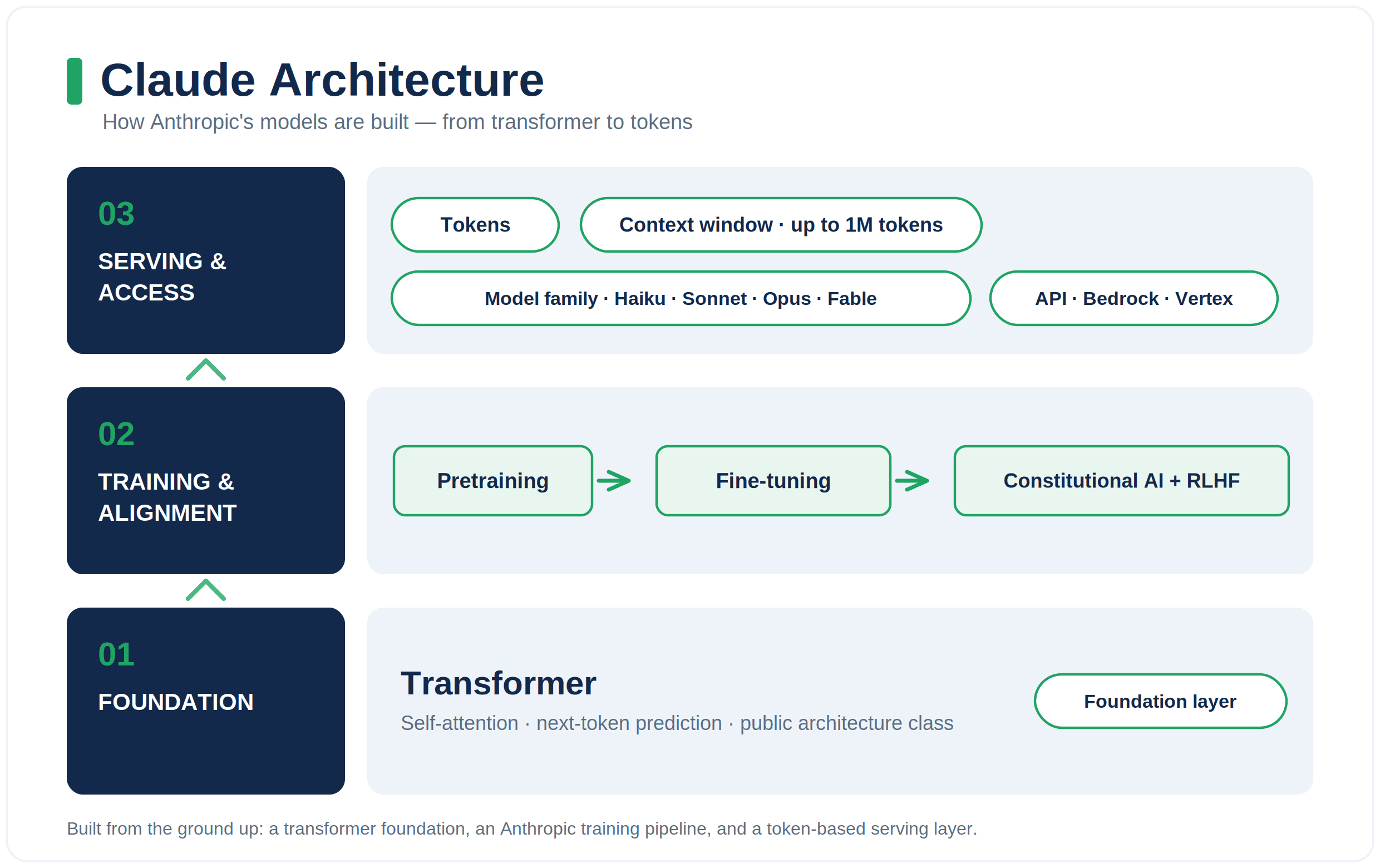
When people ask about Claude's architecture, they usually mean one or more of three things: the underlying neural network design, the process used to train and align it, and the way it is served and used. All three matter, and they are easy to conflate. The neural network is the transformer. The training and alignment is where Anthropic's distinctive work, Constitutional AI, lives. And the serving layer, tokens, context windows, and model tiers, is where the architecture meets your keyboard and your budget. We will take them in that order, because each builds on the last.
The Foundation: The Transformer
At its core, Claude is a generative pretrained transformer, the architecture that has powered essentially every frontier language model since its introduction in 2017. You do not need the mathematics to grasp the idea, and the intuition is genuinely useful.
A transformer works by predicting the next token, a token being a chunk of text, roughly a word or part of a word, given everything that came before it. That sounds almost too simple to produce intelligence. Yet, trained on enough text, next-token prediction forces the model to learn grammar, facts, reasoning patterns, and style, because predicting the next word well in a hard sentence requires understanding the sentence. The engine that makes this work is self-attention: for each token, the model weighs how much every other token in the context should influence it, so it can connect a pronoun to the noun it refers to, or a question to the clause that answers it, across long stretches of text. Think of it as the model, at every word, glancing back over everything it has read and deciding what matters most right now.
This is the part of Claude that is not secret. The transformer is public science, and Claude sits in the same architectural family as other frontier models. What distinguishes Claude is much less the network shape than what Anthropic does during training and alignment, which is where we turn next.
How Claude Is Trained
Building Claude is a pipeline, not a single step, and each stage does a different job. At a high level it looks like this.
| Stage | What happens | What it produces |
|---|---|---|
| Pretraining | Learn from a large, diverse text corpus by predicting next tokens | A base model with broad knowledge and language ability |
| Supervised fine-tuning | Train on curated examples of high-quality responses | Instruction-following and a baseline style |
| Alignment (Constitutional AI + RLHF) | Shape behavior toward helpful, honest, harmless | A model that is capable and well-behaved |
Constitutional AI: Claude's Distinctive Layer
If there is one thing that makes Claude architecturally distinctive, it is Constitutional AI. To understand it, start with what it improves on. The standard way to align a model to human values is Reinforcement Learning from Human Feedback, or RLHF: you show human raters two model responses, they pick the better one, and you repeat this across a huge number of examples until the model learns to produce outputs people prefer. It works, but it is expensive, slow, and opaque, the resulting values emerge from a statistical average of many raters, and it is hard to say exactly what the model learned or why it refuses what it refuses.
Constitutional AI takes a different route. Anthropic writes down a set of principles, a constitution, in plain language, drawing on sources like the UN Declaration of Human Rights, Anthropic's own usage policies, and AI safety research. Then, instead of relying only on humans, the model is trained to evaluate and revise its own responses against those principles. It critiques a draft answer, asks whether it aligns with the constitution, and rewrites it to comply, generating training data without a human labeling every example. A separate model then judges which responses best follow the principles, producing preference data that trains a reward model, which in turn fine-tunes Claude through reinforcement learning. Because the feedback comes from an AI guided by the constitution, this is often called RLAIF, reinforcement learning from AI feedback, and it is complemented by traditional RLHF and supervised fine-tuning rather than replacing them entirely.
| Aspect | Traditional RLHF | Constitutional AI |
|---|---|---|
| Source of feedback | Human raters comparing outputs | A model judging against written principles |
| Scalability | Limited by human annotation cost | Scales with less human labeling |
| Transparency | Values are implicit and hard to inspect | Principles are explicit and inspectable |
| Explaining refusals | Often cannot say why | Can reason from stated principles |
Two consequences matter. First, the approach scales better, because it does not need a human in the loop for every judgment. Second, and more interesting, it makes alignment more transparent: the principles are written down and can be read, debated, and revised. Anthropic published the first constitution in 2023 and released a significantly updated version in January 2026, which is unusual, most of what shapes a model's values is buried in a training process nobody outside the company can see. The goal throughout is a model that is helpful, honest, and harmless, and Claude is consistently rated among the safest frontier models in independent evaluations, which is a large part of why it appeals to enterprises in regulated fields.
Tokens and Context: How Claude Reads and Writes
Everything Claude does is mediated by tokens. Before Claude sees your prompt, it is split into tokens; as Claude responds, it generates tokens one at a time. This is not a billing detail bolted on afterward, it is the native unit of the architecture, which is exactly why token economics is the foundation of AI cost. The other key number is the context window: the maximum number of tokens Claude can consider at once, which on the newest models reaches up to a million tokens. The context window is Claude's working memory for a conversation, everything in it, your prompt, the documents you paste, the conversation so far, competes for that space, and everything in it is processed on every turn.
This has a practical shape worth internalizing. A larger context lets Claude reason over more material at once, an entire codebase, a long document, a lengthy conversation, but it also means more tokens processed, and tokens are what you pay for. Understanding this turns vague intuitions about cost into concrete levers, which we will come back to.
How Claude Generates a Response
When you send a prompt, Claude does not retrieve a stored answer; it generates one, token by token. Given your prompt and everything in context, it computes a probability distribution over what the next token should be, picks one, appends it, and repeats, each new token informed by all the tokens before it. This autoregressive generation is why responses stream in rather than appearing all at once, and why longer responses take longer and cost more: every output token is a full pass through the model.
Newer models add a wrinkle worth knowing: reasoning, or extended thinking, where the model generates intermediate reasoning tokens before its visible answer. This can dramatically improve performance on hard problems, but those thinking tokens are real tokens that take time and cost money, so a short final answer can sit on top of a great deal of hidden computation. It is one of the clearest cases where the architecture directly shapes the bill.
The Claude Model Family
Claude is not one model but a family, and the family is itself an architectural decision, one model cannot be simultaneously the fastest, cheapest, and most capable, so Anthropic offers tiers that make the trade-off explicit. Since the Claude 3 generation, the lineup has followed a consistent shape, with a frontier tier added in 2026.
| Tier | Optimized for | Relative profile |
|---|---|---|
| Haiku | Speed and low cost | Fast and cheapest; great for high-volume, simpler tasks |
| Sonnet | Balance | Strong capability at a moderate cost; the everyday workhorse |
| Opus | Maximum capability | The most capable general tier; higher cost per token |
| Frontier tier (Mythos / Fable) | The hardest frontier work | Top capability; highest cost, introduced in 2026 |
Current examples of these tiers include Claude Haiku 4.5, Sonnet 5, and Opus 4.8, with the frontier Fable and Mythos models above them, and the names advance over time as new generations ship. The practical point is that choosing a tier is the single biggest cost decision you make with Claude, the same task can cost many times more on the top tier than on a smaller one, and most routine work does not need the largest model. For current rates, see our guide to Claude pricing.
How Claude Is Accessed
Architecture also includes how a model reaches you, and Claude is deliberately available through several front doors. Directly, it is offered via Anthropic's own API for developers building applications, and through the Claude apps and web interface for everyday use. It is also served through major cloud platforms, notably Amazon Bedrock and Google Vertex AI, which let teams use Claude inside the cloud environment and billing they already run. On top of the raw model sit purpose-built surfaces such as Claude Code for software development and agentic tools that let Claude take multi-step actions.
This matters for two reasons. First, where you access Claude affects how you pay for it, a flat subscription through the apps, per-token through the API, or bundled into a cloud bill through Bedrock or Vertex, which is a real architectural-cost decision, not just a procurement one. Second, the same underlying model can behave as a chat assistant, a coding agent, or an embedded API depending on the surface, which is why understanding the model itself, separate from any one product, is so useful.
Safety Architecture
Safety is not a coat of paint on Claude; it is built into how the model is trained and operated. Constitutional AI is the training-time part, but it sits inside a broader safety architecture. Anthropic maintains a Responsible Scaling Policy that ties the deployment of more capable models to demonstrated safety safeguards, runs extensive red-teaming and evaluation, and publishes model cards and system prompts, an unusual degree of transparency for a frontier lab. At inference time, additional safeguards and classifiers can route or restrict certain requests. The result is a model designed to be difficult to misuse without being uselessly restrictive, a balance that is genuinely hard to strike and central to Anthropic's positioning.
What Claude's Architecture Means for Cost
For anyone paying for Claude, the architecture is not academic, it is the cost model. Because Claude is a transformer that processes and generates tokens, three architectural facts translate directly into your bill. Model tier is the largest lever: a bigger model costs more per token, so routing routine work to Haiku or Sonnet instead of Opus is often the fastest saving. Context length is the second: everything you put in the context window is processed and paid for on every turn, so trimming prompts and caching stable content matters. And output, including reasoning tokens, is the third: output typically costs more than input, so unbounded or verbose generation is a silent multiplier. These are the same levers we cover in our LLM cost optimization guide and FinOps for AI, and they all fall out of how the model is built. Understanding the architecture is, in a real sense, understanding the invoice.
This is why AI spend behaves so differently from traditional software cost, and why it now belongs in the same financial discipline as the rest of the cloud, a theme we develop in why AI costs are cloud costs now. The architecture makes cost variable, usage-driven, and tied to choices developers make in code, exactly the kind of spend that needs visibility and ownership.
Interpretability: Trying to See Inside
One more strand of Claude's story is unusual enough to be worth naming: interpretability. A large language model is, by default, a black box, it produces outputs without explaining the internal computation that led to them, and that opacity is a genuine safety problem. If you cannot see why a model does something, you cannot fully trust or steer it. Anthropic invests heavily in mechanistic interpretability research, the effort to reverse-engineer what is actually happening inside these networks, identifying the internal features and circuits a model uses to represent concepts and make decisions.
This is early, hard science, and it is not a finished part of the architecture you can point to like a context window. But it matters to the story, because it reflects a design philosophy: rather than treating the model as an inscrutable oracle, Anthropic treats understanding the internals as part of building safely. Constitutional AI makes the model's stated values explicit; interpretability research aims to make its internal reasoning legible too. Together they are two sides of the same ambition, an AI whose behavior you can actually account for, not just observe.
What Anthropic Doesn't Publish
Intellectual honesty requires naming the gaps, because plenty of confident writing about Claude's internals is guesswork. Anthropic does not publicly disclose the exact number of parameters in each Claude model, the specific layer counts or architectural modifications, or the precise composition of the pretraining dataset. It shares the shape of the approach, transformers, the training pipeline, Constitutional AI, the safety framework, but not the proprietary specifics that competitors would value. So if you see a precise parameter count for a current Claude model presented as fact, treat it with suspicion; the honest answer is that the general architecture is public and the exact internals are not. That distinction is worth holding onto, because it is the line between understanding Claude and inventing details about it.
How Claude Differs From Other Model Architectures
If Claude shares the transformer foundation with models like GPT and Gemini, what actually makes it different? Less than marketing implies at the network level, and more than you might think at the alignment level. All the leading models are transformers trained on vast text corpora, so their raw architecture is broadly similar, and their capabilities converge and leapfrog each other release by release. The meaningful differences live in training and alignment choices.
Claude's distinguishing bet is Constitutional AI and Anthropic's broader safety-first posture: an explicit written constitution, heavy investment in interpretability, a Responsible Scaling Policy, and a consistent emphasis on being helpful without being harmful. In independent evaluations Claude tends to rate among the safest frontier models, and that reputation, rather than a secret architectural trick, is much of what draws regulated industries to it. So the honest comparison is this: the engines are similar, the tuning philosophies differ, and for many teams the alignment approach, not a benchmark score, is the deciding factor. For a fuller head-to-head, our comparison of Anthropic and OpenAI goes deeper.
The Bottom Line
Claude's architecture is, at heart, a familiar one, a transformer that predicts the next token, made remarkable less by an exotic network design than by how it is trained and aligned. Pretraining gives it knowledge, fine-tuning gives it usefulness, and Constitutional AI gives it a set of written principles it can reason from, a genuinely distinctive approach that trades some human labeling for scale and transparency. Around that sits a family of model sizes and a safety framework designed to keep capability and trustworthiness in the same package.
For most people, the single most useful thing to take away is that Claude thinks in tokens and comes in sizes, and those two facts govern both what it can do and what it costs. Understand the architecture at that level, and you can use Claude well, choosing the right model, managing context, watching output, without needing the proprietary internals Anthropic keeps private. The machinery is elegant, but the practical wisdom is simple: match the model to the task, respect the token, and let the design work for you.
FAQs
Claude is a generative pretrained transformer, a large language model in the same broad architecture class as other frontier models. It works by predicting the next token in a sequence using self-attention. Anthropic's distinctive contribution is less the network design than its training and alignment method, Constitutional AI.
Constitutional AI is Anthropic's alignment method in which the model critiques and revises its own responses against a written set of principles, a constitution, rather than relying solely on human feedback. This generates training data with less human labeling and makes the model's values explicit and inspectable. It is complemented by traditional RLHF.
In three stages: pretraining on a large, diverse text corpus by predicting next tokens, which builds broad knowledge; supervised fine-tuning on curated high-quality examples, which teaches instruction-following; and alignment through Constitutional AI and RLHF, which shapes behavior to be helpful, honest, and harmless.
RLHF relies on human raters comparing outputs, which is expensive and produces values that are implicit and hard to inspect. Constitutional AI uses a model judging responses against written principles, which scales with less human labeling and makes the principles explicit, so the model can better reason about why it refuses certain requests.
A token is a chunk of text, roughly a word or part of one, and both Claude's input and output are measured in tokens. The context window is the maximum number of tokens Claude can consider at once, up to a million on the newest models, and everything in it is processed on each turn, which is why it drives both capability and cost.
Claude comes in a family: Haiku (fast and lowest cost), Sonnet (balanced), and Opus (most capable), with a frontier tier (Mythos and Fable) added in 2026. Current examples include Haiku 4.5, Sonnet 5, and Opus 4.8. Choosing a tier is the single biggest cost decision when using Claude.