

Updated 16 Jul 2026 • 10 mins read
GigaOm Cloud FinOps Radar v5 report

The GigaOm Radar for Cloud FinOps v5 evaluates 24 vendors across key features, emerging capabilities, and business criteria. Nine earn Leader status, with CloudBolt, Flexera, Kion, and UnityOne AI named Outperformers. The market is shifting from reactive cost reporting toward AI-driven optimization, unit economics, and platform convergence across cloud, SaaS, and AI spend. FOCUS standardization and sustainability tracking are accelerating.
Let us be honest with you. The GigaOm Radar for Cloud FinOps v5 is a fantastic report. It is also nearly 60 pages long. That is a lot of reading for anyone who is not a full-time analyst, and most of us have dashboards to watch, budgets to defend, and at least three Slack channels demanding attention at any given moment.
So we read it for you. Cover to cover. Every vendor profile. Every scoring table. Every footnote.
This blog is designed to give you everything you need to understand the full GigaOm Radar report without having to carve out half a day to read it yourself. We have distilled the key findings, mapped out the vendor landscape, highlighted what matters most for FinOps practitioners, and added our own perspective from the engineering trenches at Opslyft.
Where to find the original report: The full GigaOm Radar for Cloud FinOps v5 was authored by Dana Hernandez (Subject Matter Expert) and published by GigaOm in 2026. It evaluates 24 cloud FinOps vendors across key features, emerging capabilities, and business criteria. You can access it through GigaOm's research portal at gigaom.com.
Why it matters: If your organization is evaluating FinOps tools, planning a vendor switch, or simply trying to understand where the market is headed, this is the most comprehensive independent benchmark available right now. Our summary saves you 55 pages of effort while preserving the insights that actually drive decisions.
What Exactly Is the GigaOm Radar Report?
The GigaOm Radar is a technology-focused evaluation framework. It plots vendor solutions across concentric rings, with vendors closer to the center judged as having the most complete solutions. Each vendor is assessed on two axes: Maturity versus Innovation, and Feature Play versus Platform Play.
What makes this report different from a typical analyst comparison is its depth. Every vendor is scored across 8 key features, 8 emerging features, and 6 business criteria. Key features and business criteria carry the highest weight in determining radar positioning, while emerging features carry a lower weight but signal where the market is heading.
One important note: the Radar is purely technology-focused. Market share, brand recognition, customer count, and vendor revenue do not factor into the scoring. A smaller vendor with exceptional technology can outrank a household name. As engineers, we appreciate that kind of objectivity. The code does not care about your marketing budget.
The 2026 Cloud FinOps Vendor Landscape at a Glance
This year's report evaluates 24 vendors. That is a significant number, reflecting both the maturity and the fragmentation of the cloud FinOps market. Let us start with how they are classified.
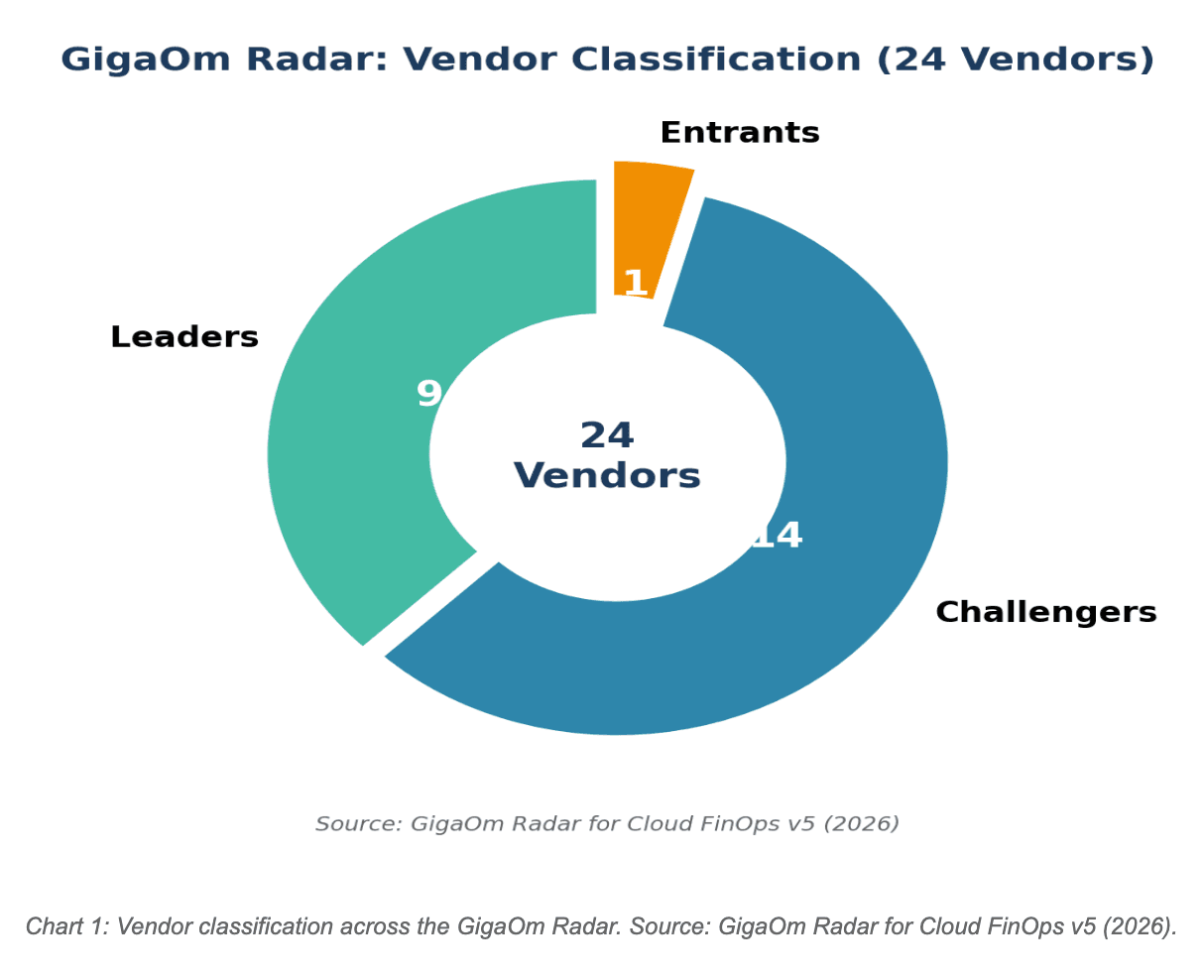
Nine vendors earned Leader status, fourteen are classified as Challengers, and one is an Entrant. Among the Leaders, four are designated as Outperformers, meaning they are projected to make the most significant forward movement over the next 12 to 18 months.
Leaders, Challengers, and Outperformers
| Vendor | Classification | Movement | Quadrant |
|---|---|---|---|
| CloudBolt | Leader | Outperformer | Innovation / Platform Play |
| Flexera | Leader | Outperformer | Maturity / Platform Play |
| Kion | Leader | Outperformer | Innovation / Platform Play |
| UnityOne AI | Leader | Outperformer | Innovation / Platform Play |
| Exivity | Leader | Fast Mover | Innovation / Feature Play |
| Harness | Leader | Fast Mover | Innovation / Platform Play |
| HPE Morpheus | Leader | Fast Mover | Innovation / Platform Play |
| IBM | Leader | Fast Mover | Maturity / Platform Play |
| Ternary | Leader | Fast Mover | Innovation / Platform Play |
Where the Vendors Actually Sit: Quadrant Analysis
The radar's two-axis system creates four quadrants, and understanding which quadrant a vendor falls into tells you a lot about its approach and DNA.
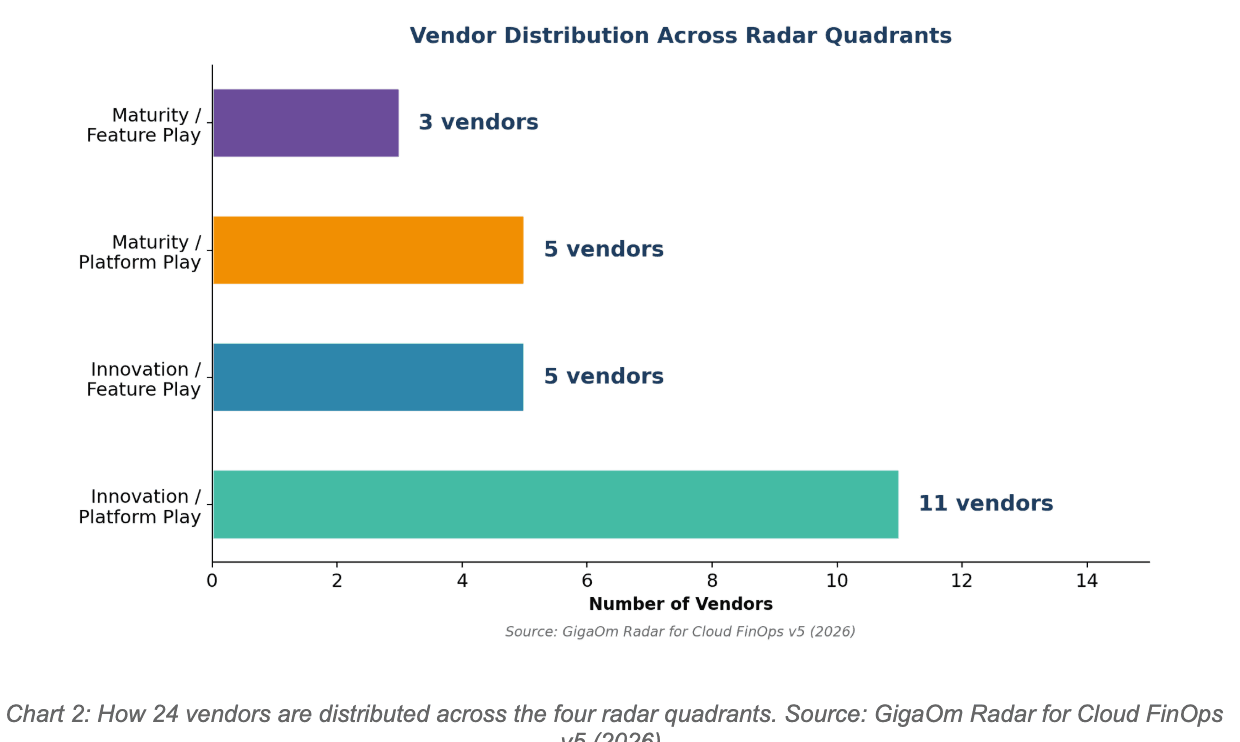
The Innovation / Platform Play quadrant is by far the most crowded with 11 vendors. This makes sense. The FinOps market is still relatively young and evolving rapidly. Many vendors are building broad platform capabilities that extend beyond just cost visibility into areas like AI cost management, automated remediation, and lifecycle orchestration.
Vendors in the Maturity half of the chart have had platforms in the FinOps market for a long time. Several are key members of the FinOps Foundation. They continue to be strong players but tend to add new functionality at a slower pace or through acquisitions.
The Innovation / Feature Play quadrant houses vendors with strong but narrower capabilities. Some focus specifically on billing accuracy, others on short-term optimization, and some specialize in intelligent forecasting. These vendors often get paired with a broader solution to provide depth in a particular area.
From the engineering side: the fact that 11 out of 24 vendors sit in the Innovation / Platform Play quadrant tells us something important. The market is consolidating around platforms, not point solutions. If you are evaluating tools today, make sure you are picking something that will grow with you, not something you will need to replace in 18 months.
The 8 Key Features: Where Good Separates From Great
Every evaluated vendor clears a table-stakes bar, multi-cloud pricing extraction, budget alerts, security controls, shared-cost handling, allocation and showback, tagging, so the differentiation lives in the eight key features GigaOm scores above it. Three deserve emphasis. Normalized cloud vendor billing is the foundation everything else stands on: in a multi-provider estate, decisions require directly comparable costs, and every capability downstream inherits this layer's quality. Rate optimization and optimization-opportunity identification carry the highest immediate impact, they are where scored capability converts to saved dollars. And FOCUS format support is the future-proofing feature: with the open billing standard now shipping twice-yearly releases and broad provider adoption, the report notes the architectural difference between vendors built natively on FOCUS, CloudBolt being the cited example, and those retrofitting support afterward.
The 8 Emerging Features: The Market's Direction
- Most mature of the emerging set: container and serverless support, predictive modeling, and intelligent anomaly detection, unsurprising, given mainstream Kubernetes adoption and the natural evolution past threshold alerting.
- Most consequential: AI cost management, as GenAI workloads scale, token and model-level cost control is moving from differentiator toward requirement, the trajectory our AI cost optimization guide documents from the practitioner side.
- Least mature: sustainability and carbon tracking, at roughly 45 percent market readiness, with most vendors offering limited reporting or spreadsheet exports, a gap regulatory pressure is unlikely to tolerate for long.
- Also scored: SaaS license management and the broader spend-scope expansion features that foreshadow the analyst outlook below.
The Analyst's View: Three Futures of Cloud FinOps
The Analyst's Outlook: Three Futures for FinOps
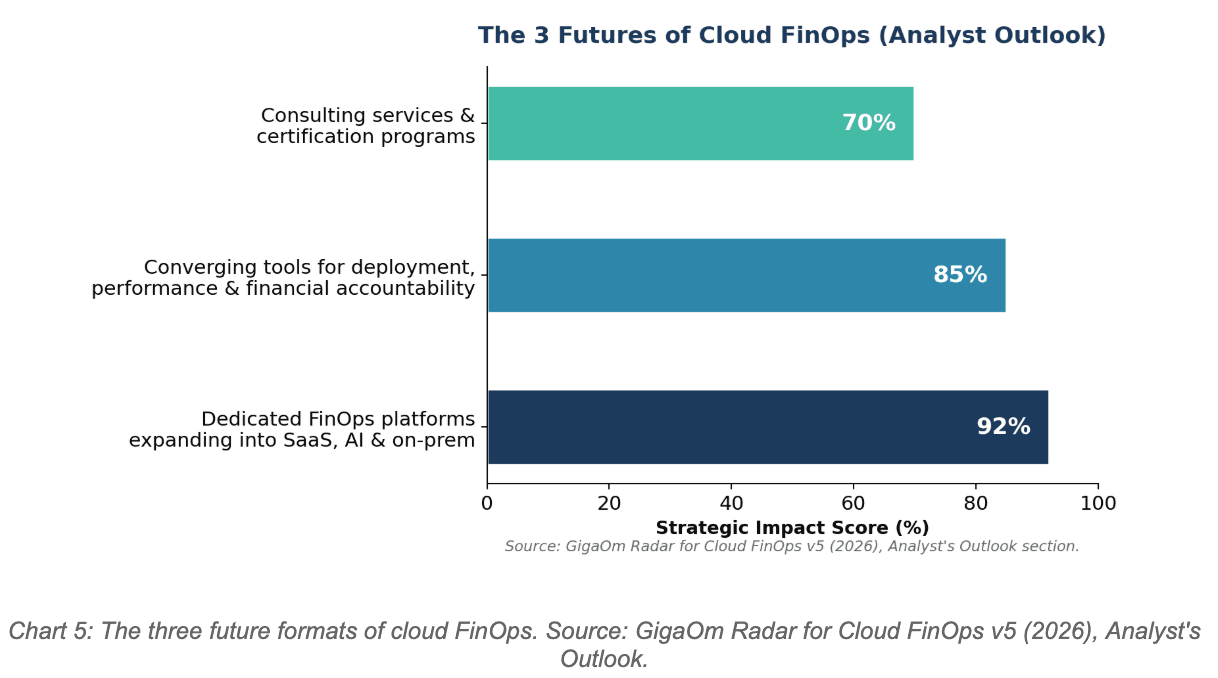
The report's forward-looking section sketches three converging trajectories. First, and in our view most transformative: dedicated FinOps platforms expanding beyond cloud into SaaS, AI, and on-premises spend, the unified technology-estate view, which aligns with where the FinOps Foundation's own scope has moved. Second: the merging of deployment management, performance optimization, and financial accountability into single workflows, cost, performance, and delivery decisions made in one place rather than three tools. Third: the professionalization layer, consulting and certification, with the report noting near-universal FinOps Foundation membership across the 24 vendors, including 10 premier memberships and 14 certified platforms. Readers of our State of FinOps 2026 analysis will recognize all three: the analyst view and the practitioner survey are describing the same convergence from opposite ends.
How Buyers Should Actually Use Radar v5
- Use it to shape the shortlist, not end it: the Radar scores technology completeness, and your decision also needs fit, your clouds, your Kubernetes and AI share, your finance workflows.
- Match quadrant to complexity: hybrid, multi-cloud, AI-heavy estates point toward Platform Play vendors; a narrow, acute need may justify a Feature Play specialist alongside one.
- Weigh the emerging features by your roadmap: AI cost management and predictive capability feel optional, exactly until the quarter they are not.
- Verify on your own data: run a proof-of-value against your billing, per the evaluation question set, because scored capability and demonstrated capability on your estate are different facts.
- Revisit the build-versus-buy temptation with honest math and the build-versus-buy framework, since a 24-vendor field advancing this fast is a strong argument for maintenance burden.
Quick Reference: Key Takeaways at a Glance
| Dimension | Key Finding |
|---|---|
| Total vendors evaluated | 24 (9 Leaders, 14 Challengers, 1 Entrant) |
| Top Outperformers | CloudBolt, Flexera, Kion, UnityOne AI |
| Most crowded quadrant | Innovation / Platform Play (11 vendors) reflecting the young, fast-evolving market |
| Most critical key feature | Normalized cloud vendor billing (foundation for every other capability) |
| Most impactful emerging feature | AI cost management and intelligent anomaly detection |
| Least mature emerging feature | Sustainability and carbon footprint tracking (still early stage) |
| Market direction | Moving from reactive reporting to proactive AI-driven optimization with unit economics |
| FinOps Foundation standard | FOCUS format adoption accelerating; SCOPES framework extending into SaaS and PaaS |
Conclusion
The GigaOm Radar for Cloud FinOps v5 paints a picture of a market that is maturing rapidly but still full of movement. Nine Leaders, four Outperformers, and a strong cluster of Innovation-focused platform vendors tell us that the FinOps tooling landscape is consolidating around broader, AI-powered platforms that go well beyond basic cost visibility.
For organizations evaluating vendors today, the report makes a few things clear. First, look beyond just billing accuracy. The table stakes are table stakes for a reason. What will differentiate your FinOps program is unit economics, AI cost management, automated remediation, and native support for the FOCUS standard. Second, pay attention to the emerging features. Sustainability tracking, SaaS license management, and predictive modeling may feel optional today, but they will be core requirements within 18 months. Third, choose a platform that matches your complexity. If you are running a hybrid, multi-cloud environment with growing AI workloads, you need a Platform Play vendor, not a Feature Play specialist.
At Opslyft, we believe the best FinOps tool is the one that gives your engineering, finance, and leadership teams a single, shared view of reality. The vendors that deliver that clarity will win. The ones that don't will become features inside someone else's platform.
The FinOps market is no longer about whether you need a tool. It is about whether the tool you pick can keep up with you.
FAQs
It is a comprehensive evaluation of 24 FinOps vendors based on features, innovation, and business criteria, highlighting market leaders and trends.
CloudBolt, Flexera, Kion, and UnityOne AI stand out as top outperformers with strong innovation and platform capabilities.
AI workloads can significantly increase cloud expenses, making cost visibility and optimization essential for maintaining financial control.
FOCUS is an open specification that standardizes cloud billing data, enabling better cost comparison and improved financial decision-making.