Template-guided allocation vs Virtual Tag upkeep
Opslyft uses allocation templates and plain-language rules to split costs automatically, instead of manually maintaining Virtual Tags.
See how Opslyft’s template-based allocation works
Loading...
Opslyft is the FinOps360 platform across your whole cloud bill. CloudHealth is an enterprise cost-governance suite for traditional cloud infrastructure.
TRUSTED & COMPLIANT
G2 Rating
Trusted by leading enterprises worldwide









TYPICAL SAVINGS RANGE
MEDIAN TIME TO VALUE
FORECAST ACCURACY
PLATFORMS SUPPORTED
Capabilities across eight functional areas. Yes means production-grade, Limited means partial coverage, dash means not generally available.
| Capability | Opslyft | CloudHealth |
|---|---|---|
| Visibility & Allocation | ||
| Cost allocation without perfect tagging | Yes | Limited (tag dependent) |
| FinOps360 platform breadth (Observability, Governance, Optimization) | Yes (16 modules) | Yes (no AI or LLM modules) |
| Rule-based allocation engine | Yes (allocation engine) | Yes (Perspectives) |
| Multi-tenant cost attribution | Yes | Yes (FlexOrgs) |
| Observability | ||
| Dashboarding and anomaly detection (incl. spike-window analysis) | Yes | Yes (seasonality aware) |
| Resource and asset inventory across providers | Yes (Resources module) | Yes (Asset reports) |
| Unit cost or cost per business metric | Yes (Unit Metrics) | Yes (unit economics) |
| Custom dashboards and saved views | Yes (Views) | Yes (FlexReports) |
| Snowflake spend visibility and optimization | Yes | No |
| Optimization | ||
| Kubernetes pod or namespace cost allocation | Yes (managed Prometheus) | Yes (OpenCost based) |
| RI or Savings Plan automation | Yes | Limited (recommendations) |
| Discount management | Yes | Yes |
| Idle and underutilized resource optimization | Yes | Yes |
| Governance & Forecasting | ||
| Engineering and finance reconciliation (showback, chargeback, veto) | Yes | Limited (showback, chargeback) |
| Budget management (forecast vs actual) | Yes | Yes |
| Cloud cost forecast accuracy | Yes (92% benchmark) | Yes (no published number) |
| Median time to value | Yes (8 days) | Weeks |
| Pricing transparency | Yes | Limited (percent of spend, custom) |
| AI & Automation | ||
| ChatGPT for Cloud (conversational AI) | Yes | Yes (Intelligent Assist) |
| MCP (Model Context Protocol) serverMCP is an open standard that lets AI agents securely connect to external tools, data and APIs. | Yes | No |
| AI-assisted recommendations with approval gates | Yes | Limited (policy driven) |
| Integrations & Architecture | ||
| Cloud and workload coverage | Yes (7 environments) | Yes (incl. data center) |
| Auto-allocation of new untagged resources (drift detection) | Yes (AI rule-based tagging) | Limited (Dynamic Group rules) |
| Business mapping (team, product, customer) | Yes | Yes (Perspectives, FlexOrgs) |
| GitHub billing support | Yes | No |
| Slack or Microsoft Teams alerts | Yes | Yes |
| FOCUS 1.2 spec supportFOCUS is the FinOps Open Cost and Usage Specification, normalizing billing data across providers into one schema. | Yes | Partial (FlexReports template) |
| Additional Integrations | ||
| Jira | Yes | Limited (via API) |
| Databricks | Yes | No |
| Enterprise & Trust | ||
| SOC 2 Type II compliance | Yes | Yes |
| SSO and role-based access control | Yes (on every tier) | Yes (FlexOrgs RBAC) |
| Time to first dashboard | Yes (days) | Weeks |
Join hundreds of engineering teams who trust Opslyft to optimize their cloud infrastructure costs.
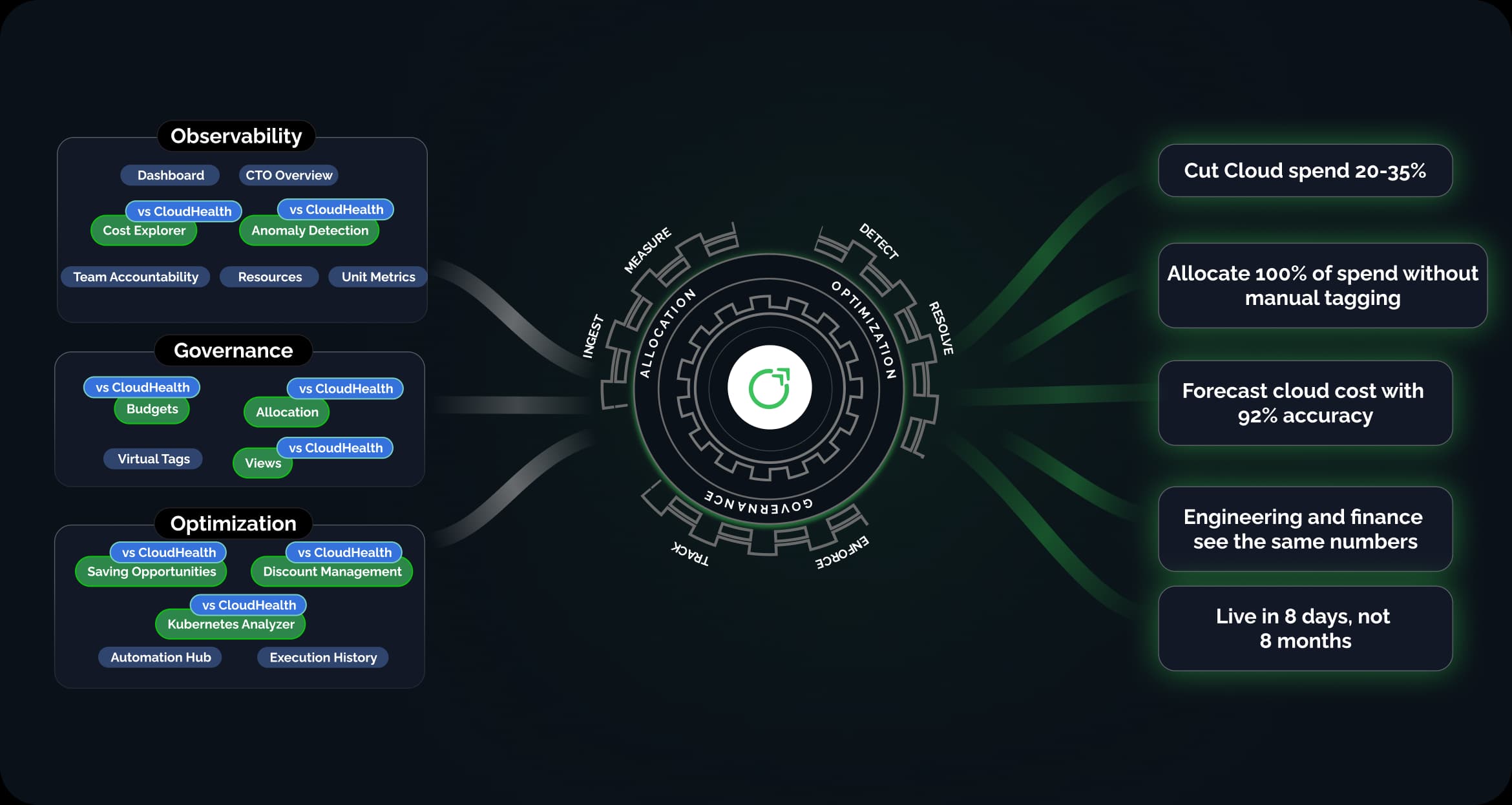
Three product-mechanic differences a FinOps buyer feels every week not generic feature counts.
Opslyft uses allocation templates and plain-language rules to split costs automatically, instead of manually maintaining Virtual Tags.
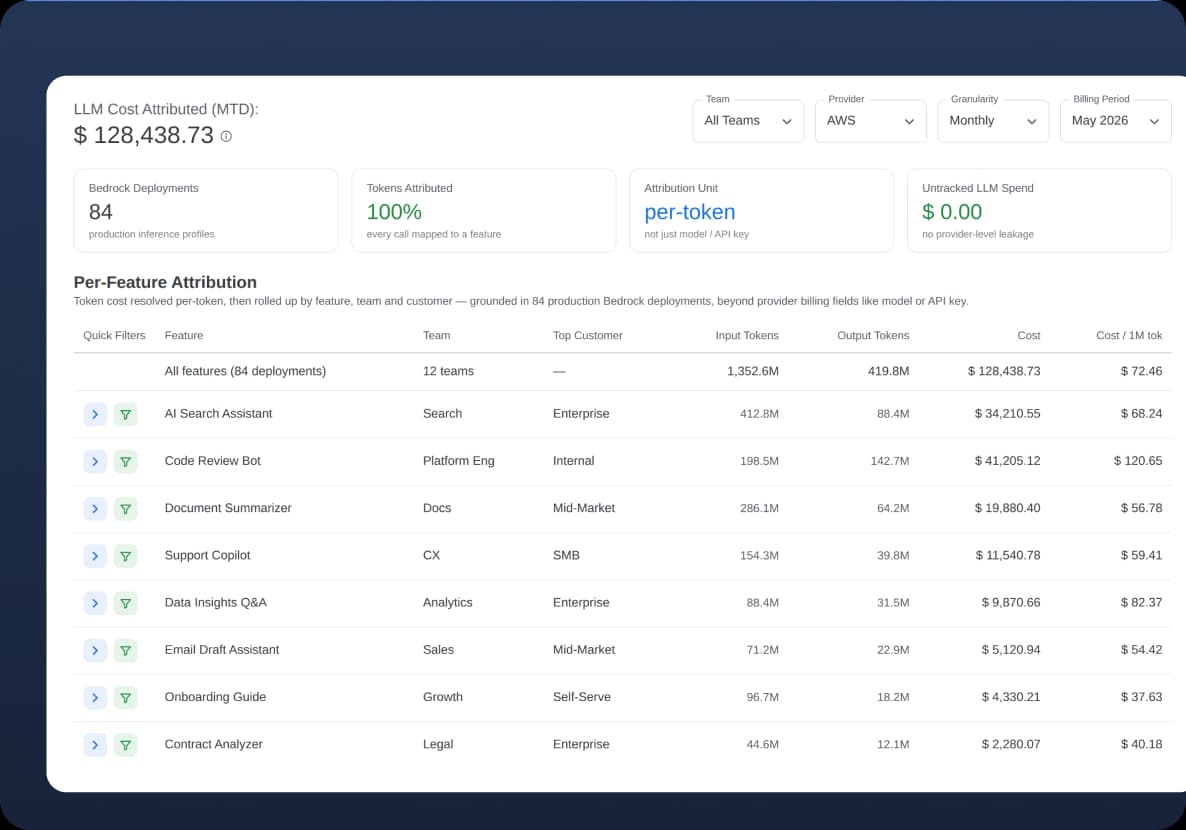
See how Opslyft’s template-based allocation worksOpslyft tracks AI/LLM usage and token costs alongside cloud, Kubernetes, compute, and storage spend in the same dashboards, budgets, and chargeback workflows.
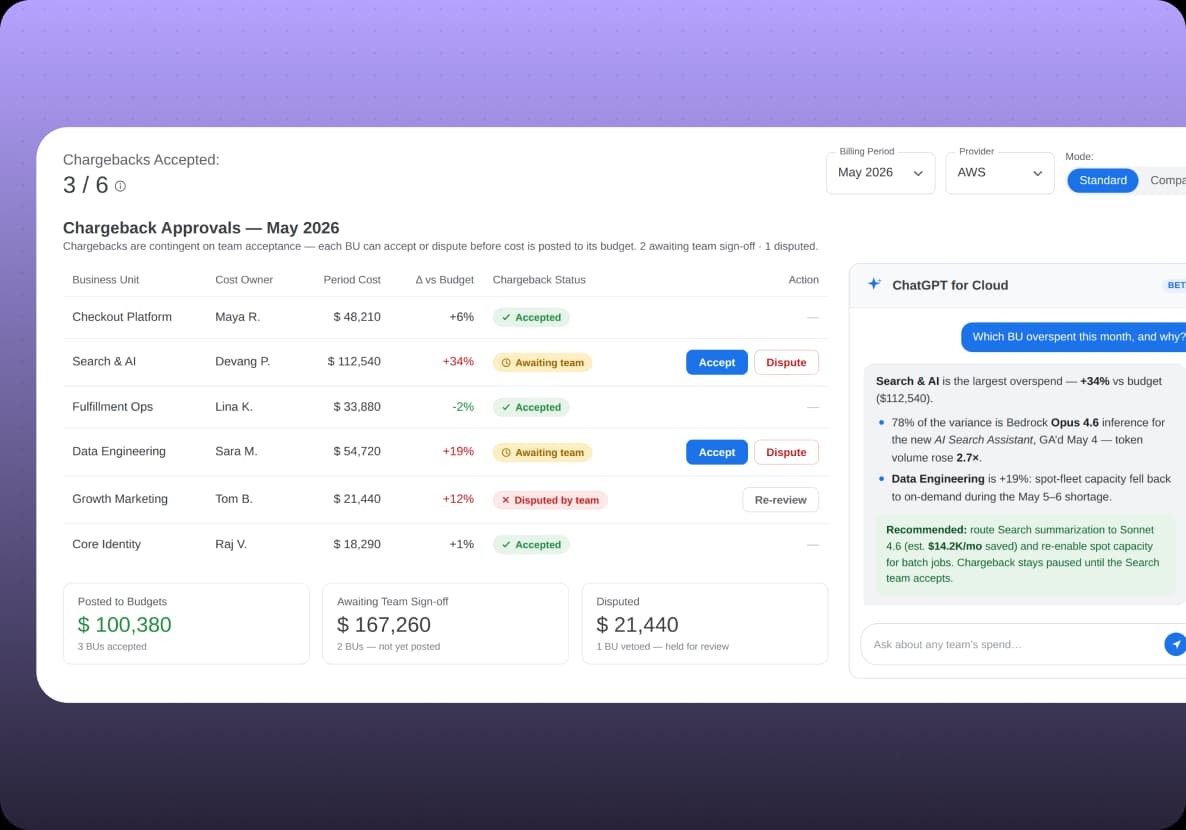
CloudHealth gives finance a read-only Cost Report link with no veto on chargeback. Opslyft makes chargebacks contingent on team acceptance, with ChatGPT for Cloud explaining which BU overspent and why.
Six roles that show up in a real evaluation. Not every role belongs on Opslyft, and not every role is served by a Kubernetes-only tool.
OWNS THE FINOPS PRACTICE END TO END
Choose Opslyft if
Choose CloudHealth if
PLATFORM / DEVOPS · RATE & USAGE OPTIMIZATION
Choose Opslyft if
Choose CloudHealth if
FP&A · ALLOCATION, CHARGEBACK, FORECAST
Choose Opslyft if
Choose CloudHealth if
CTO / VP ENG / CFO · BOARD REPORTING
Choose Opslyft if
Choose CloudHealth if
SERVICE OWNERS · UNIT ECONOMICS
Choose Opslyft if
Choose CloudHealth if
RI'S, SAVINGS PLANS, EDP, CONTRACTS
Choose Opslyft if
Choose CloudHealth if
Two honest pricing models for two different jobs; pick the one that matches how your team buys and what you need to allocate.
01 FinOps360 Platform
Closed-loop visibility, governance & optimization across every cloud.
Scales with accounts
Custom
Scoped after a discovery call
02 Enterprise percentage of spend
Percentage-of-spend pricing on an annual or multi-year enterprise contract.
~2.2-2.5%
of tracked cloud spend
Opslyft’s support team feels like a true partner; always proactive and reliable. Their platform gives us clear visibility into AWS, Azure & Snowflake spend to track trends and spot cost spikes.


It's fantastic to work with team Opslyft on building a cost-efficient & secure infrastructure. A stellar product and excellent customer support!


Opslyft has consistently stayed ahead of the curve in FinOps by building a robust platform that adds meaningful features that solve real challenges in cloud cost management.

The results in the first two months of using OpsLyft itself are really amazing. I don’t know if I have come across any startup team that offers the customer support as they do.