Last Updated: April 2026
FinOps: The Complete Guide to Cloud Financial Management in 2026
FinOps is a collaborative approach that brings finance, engineering, and operations together to manage and optimize cloud spending in real time. Balancing cost, performance, and business value through shared accountability and data-driven decisions.
START OPTIMIZINGSummary
FinOps is the practice of bringing financial accountability to cloud spending. It unifies engineering, finance, and product teams around shared cost data. Through visibility, allocation, and continuous optimization, organizations typically recover 25–50% of wasted cloud spend. It is not cost-cutting; it is spending smarter as you scale
Cloud spending is no longer a cost centre problem. It is an engineering problem, a product problem, and a strategy problem. When teams can provision infrastructure in minutes but cannot see where that spend is going for weeks, the gap between cloud agility and financial accountability becomes a liability. This is exactly why FinOps exists.
FinOps, short for cloud financial operations, is the practice of bringing financial accountability to the variable spend model of cloud. It gives organizations a framework to understand, control, and continuously optimize cloud costs without slowing down the velocity of engineering teams.
This guide covers everything: what FinOps is, how it works, what tools power it, how cloud cost allocation functions in practice, and what it takes to build a mature FinOps culture that drives real savings.
FinOps at a Glance
If your team cannot clearly see where cloud spend is going across services and accounts, optimization becomes guesswork. The first step is centralizing billing data and building visibility. Explore how Opslyft helps teams do this: Opslyft
What is FinOps?
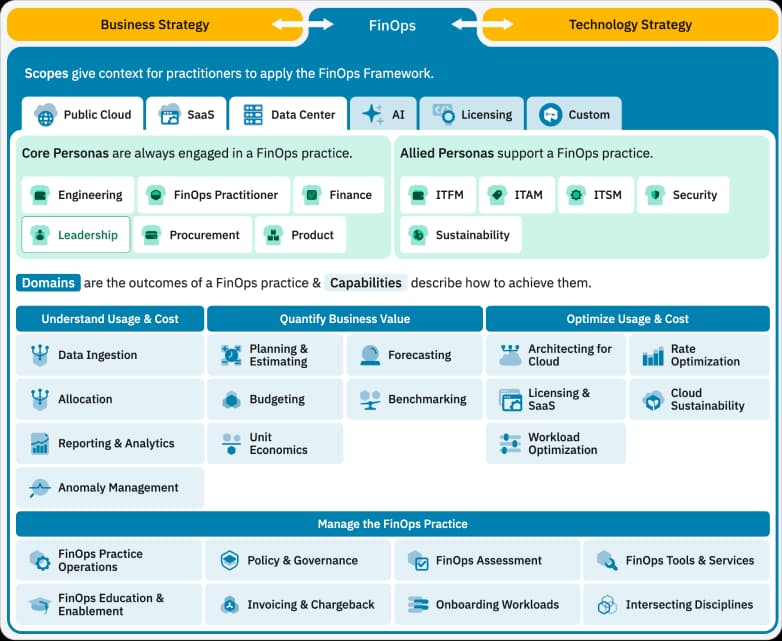
FinOps is a cultural practice and operational framework for managing cloud financial operations. It unifies cloud cost management, financial planning, and engineering accountability into a single, continuous workflow.
At its core, FinOps is not a tool or a team. It is a cross-functional operating model where finance, engineering, and product work together to make informed decisions about cloud spend in real time.
The FinOps Foundation defines it as: the practice of bringing financial accountability to the variable spend model of cloud. Teams that adopt it gain the ability to not just reduce costs but to understand the true value of every dollar spent on cloud infrastructure.
FinOps Meaning and Evolution
The term FinOps emerged as cloud adoption accelerated. Traditional IT budgeting was designed for capital expenditure, large upfront purchases approved annually. Cloud changed this to an operational expense model, where costs scale dynamically with usage. Finance teams were not built for this model. Neither were most engineering organizations. FinOps was the answer.
The FinOps Foundation, established in 2019, formalized the discipline by publishing a shared framework, FinOps KPIs, a maturity model, and a certification program that now has practitioners in over 5,000 organizations worldwide.
Today, FinOps has expanded beyond basic cloud cost management. With the rise of generative AI workloads, FinOps for AI has become one of the fastest-growing subcategories, helping teams govern GPU spend, token usage, and model inference costs alongside traditional compute.
Why FinOps Matters
28-35%
CLOUD WASTE
On a $5M annual cloud spend, this translates to over $1.5M in recoverable savings.
Cloud waste is not a small problem. According to cloud computing research, organizations waste between 28 and 35 percent of their cloud budget on idle resources, over-provisioned instances, and untagged infrastructure. On a $5M annual cloud spend, this translates to over $1.5M in recoverable savings.
The problem is structural. Engineering teams optimize for speed. Finance teams optimize for predictability. Without a shared language and shared data, cloud costs drift out of control.
FinOps solves this by creating a feedback loop between spend and decisions. Engineers see the cost impact of their architecture choices. Finance teams see real-time spend instead of month-old reports. Product teams can measure cloud cost per feature. Everyone is aligned.
Core Components of FinOps
Understanding FinOps requires understanding its three foundational phases, supported by several operational pillars. We will explore each in depth in the sections that follow. For a deeper overview of FinOps principles, see our FinOps best practices guide.
- Visibility: Unified cost data across all cloud providers and services
- Allocation: Mapping spend to teams, products, and business outcomes
- Optimization: Acting on insights to reduce waste and improve unit economics
- Governance: Budgets, anomaly alerts, and policy enforcement
- Culture: Shared ownership of cost across engineering and finance
Teams that cannot see their costs at the team or service level are operating blind. Building allocation is the second step after visibility. See how OpsLyft maps spend to business units automatically.
FinOps Lifecycle
The FinOps lifecycle is a three-phase iterative loop, not a one-time project. It runs continuously as cloud environments scale and evolve.
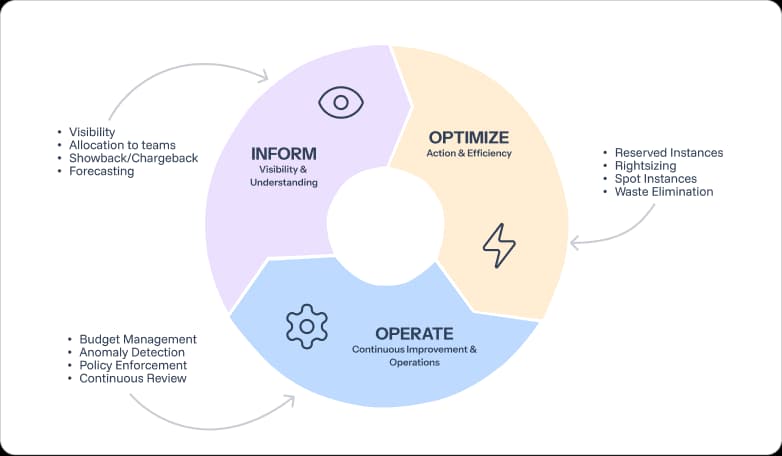
The inform phase is about visibility. Teams pull billing data from all cloud providers, tag resources, allocate costs to teams and products, and build dashboards. Without this phase, every other action is guesswork. This connects directly to cloud cost allocation, which we cover in depth below.
Once costs are visible and attributed, teams can act. Optimization includes rightsizing instances, deleting idle resources, purchasing reserved capacity, and applying cloud cost optimization strategies systematically. This phase is where most of the financial impact happens.
The operate phase embeds FinOps into the engineering workflow. Teams set budgets, configure cloud cost anomaly detection alerts, track KPIs, and run regular cost reviews. This phase ensures that savings do not erode as new workloads are deployed. It also drives the FinOps culture changes that sustain the practice long term.
Cloud Cost Optimization
Cloud cost optimization is the operational layer of FinOps. It is the set of actions teams take to reduce unnecessary cloud spend without compromising performance or reliability. It connects directly to what cloud optimization means at the infrastructure level.
The most common optimization actions include:
- Rightsizing compute instances to match actual workload requirements
- Eliminating idle or orphaned resources that are running but unused
- Purchasing reserved instances or savings plans for predictable baseline workloads
- Implementing auto-scaling to match capacity with demand dynamically
- Optimizing Kubernetes workloads by setting accurate resource requests and limits
- Using AI-powered optimization to identify patterns humans miss
For teams building multi-cloud strategies, optimization becomes more complex but also more impactful, as each provider has different pricing models, discount structures, and efficiency levers.
Cloud Cost Reduction Strategies
Cost reduction and cost optimization are related but different. Optimization improves efficiency. Reduction eliminates spend categories entirely. Both are necessary. See 4 warning signs your cost strategy is failing to understand when reduction is urgent.
- Deleting unused snapshots, volumes, and load balancers
- Consolidating underutilized accounts and environments
- Reviewing cloud service provider choices for workload fit
- Negotiating enterprise discount programs and committed use contracts
- Replacing overprovisioned managed services with right-sized alternatives
At $3M annual cloud spend, a 20 percent reduction represents $600K returned to the business. Teams that apply cloud cost elasticity thinking understand that every architecture decision has a cost dimension.
Cloud Cost Allocation: The Foundation of Accountability
Cost allocation is the process of distributing cloud spend to the teams, products, services, or business units that generated it. Without allocation, FinOps best practices cannot take hold because nobody owns the numbers.
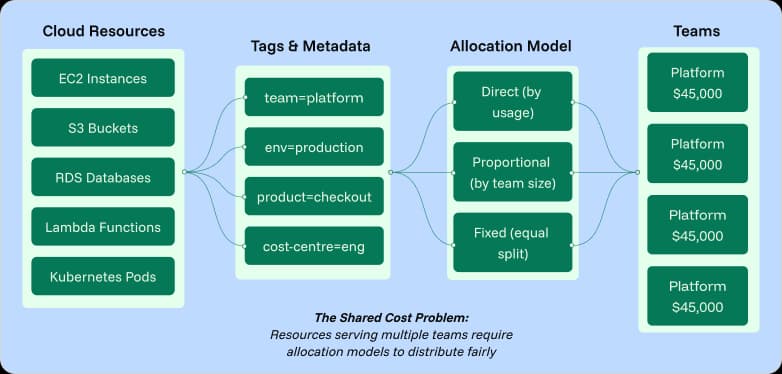
We explore this in detail in our 6 FinOps practices for cloud cost allocation guide. Here is the structural breakdown:
Tagging vs. Allocation Models
Tagging is the most common approach to cost allocation. Teams attach metadata tags to cloud resources that identify the owner, environment, product, and cost centre. Azure tagging best practices and cloud tagging strategies guide teams on building reliable tag taxonomies.
However, tagging alone is insufficient. Resources that cannot be tagged, such as shared networking, managed databases, and platform services, create allocation gaps. This requires allocation models that distribute shared costs proportionally based on usage, headcount, or revenue attribution.
The Shared Cost Problem
Shared costs are the hardest part of cloud cost allocation. A single Kubernetes cluster, a shared data platform, or a centrally managed security service may serve ten teams. Without a defined allocation model, these costs sit unassigned and erode cost accountability.
The three common models for shared cost distribution are direct allocation (by usage), proportional allocation (by team size or revenue), and fixed allocation (equal split). The right model depends on the organization. See FOCUS in FinOps, the emerging standard for cloud cost data, which is making shared cost allocation more consistent across providers.
Cost Attribution Challenges
Even with good tagging and allocation models, attribution is hard. Teams that are building in-house cost platforms often underestimate the ongoing maintenance burden. Keeping tags current as infrastructure changes, handling multi-tenancy, and normalizing data across AWS, GCP, and Azure is a significant operational effort.
This is why dedicated FinOps platforms handle attribution automatically using resource metadata, billing APIs, and usage data rather than relying entirely on manual tagging. Learn more about cloud financial planning tools that automate this layer.
Unit Economics in FinOps
Unit economics is one of the most powerful and underused concepts in FinOps. It means measuring cloud cost relative to a business output: cost per customer, cost per API call, cost per transaction, or cost per feature. Learn more about how to optimize cloud usage at this level.
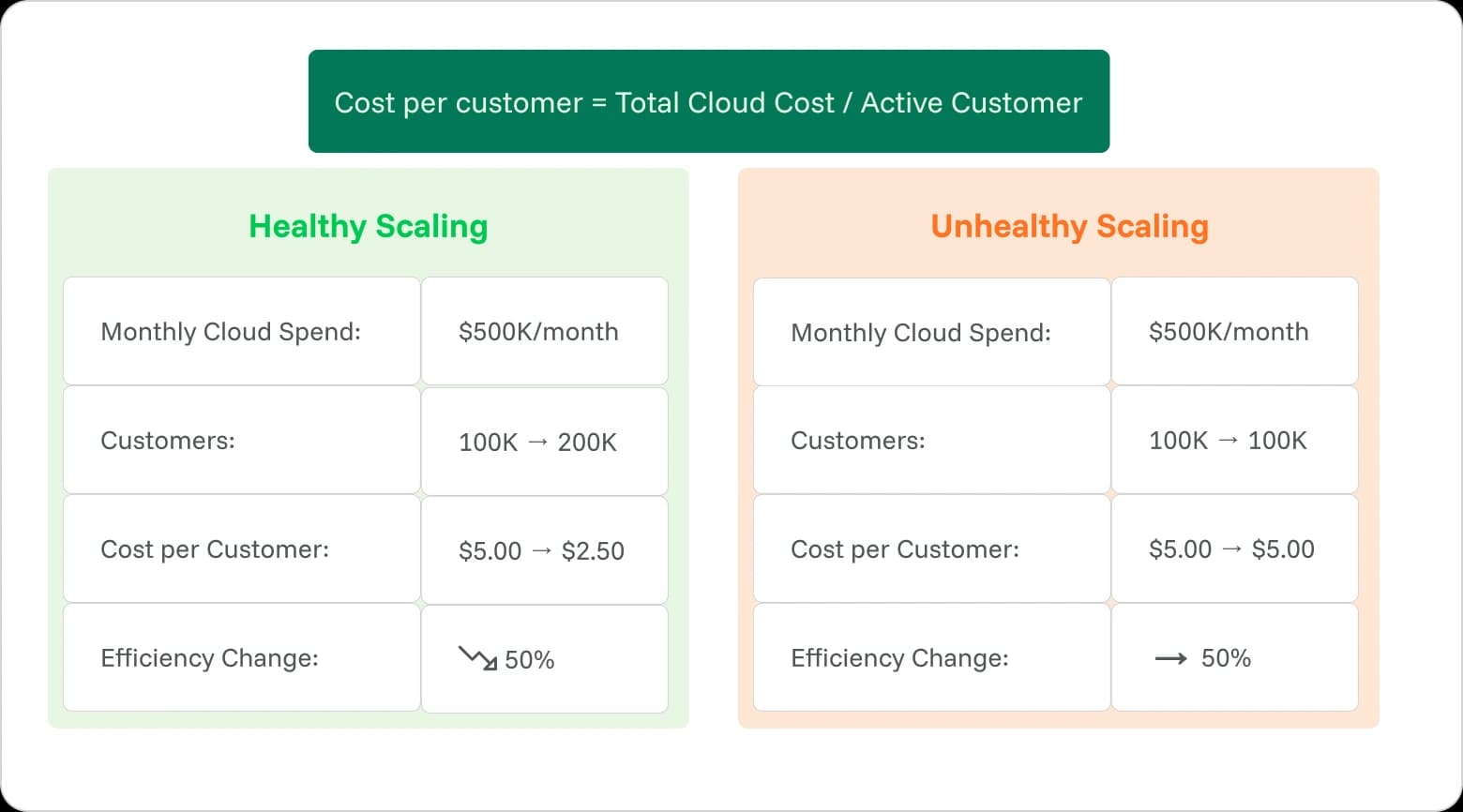
When teams only track total spend, they cannot answer the most important question: is our cloud efficiency improving as we grow? A team spending $500K per month that serves twice as many customers as last year at the same cost is winning. A team spending $500K per month serving the same customers is losing.
Cost Per Customer
Dividing the total infrastructure cost for a product by the number of active customers gives cost per customer. This metric connects engineering decisions directly to business margins. If cost per customer rises as you scale, there is an architectural problem.
Cost Per Feature or Workload
Allocating compute, storage, and network costs to specific features or workloads gives product teams a financial signal about what is expensive to run. This is where engineering teams understanding cloud costs becomes critical. Engineers who know their feature costs $0.04 per user per month make better architectural decisions than engineers who do not.
On a $5M annual cloud spend with 100,000 customers, cost per customer is $50 per year. If that number is trending up quarter over quarter, the business has a cloud efficiency problem that no amount of reserved instances will fully solve.
Cloud Cost Forecasting
Why Cloud Forecasting Fails
Cloud forecasting is harder than traditional IT budgeting for three reasons. First, cloud usage is dynamic: workloads scale up and down, new services are provisioned constantly, and environments are spun up for experiments and never cleaned up. Second, pricing changes: providers update pricing, introduce new instance types, and change discount structures. Third, organizational behavior is unpredictable: a product launch, a new team, or a traffic spike can double spend overnight.
Static annual budgets do not work for cloud. Teams that rely on spreadsheet-based forecasting consistently undershoot or overshoot by 20 to 40 percent.
Unpredictable Cloud Usage and Dynamic Scaling
The variability of cloud is its strength and its forecasting enemy. Cloud elasticity means that resources scale in response to demand automatically, but that also means costs scale automatically. Cloud scalability patterns that drive business growth also drive cost variability.
Effective forecasting combines historical trending with workload-specific growth rates and planned infrastructure changes. Machine learning-based forecasting tools can identify patterns in billing data that humans miss, significantly improving forecast accuracy.
Anomaly Detection in Cloud Cost
Anomaly detection is the practice of automatically identifying unusual spikes or drops in cloud spend. It is essential because cloud costs can change dramatically in hours, and a team relying on monthly billing reviews will not catch a $50K overage until it is too late. This connects to cloud cost forecasting and anomaly detection as a paired capability.
Reactive vs. Proactive Monitoring
Real-Time Alerts and Cost Governance
Real-time cost alerts are the bridge between data and action. When cloud security governance is combined with cost governance, teams get a unified view of both compliance risk and financial risk. Cloud DevOps practices that incorporate cost gates in CI/CD pipelines can catch expensive changes before they reach production.
If your cloud spend has ever spiked unexpectedly and you found out weeks later, anomaly detection is the tool that prevents this. OpsLyft surfaces cost anomalies in real time across AWS, GCP, and Azure. See it in action at Opslyft
FinOps Tools: Native vs. Dedicated Platforms
Every major cloud provider offers native cost management tools. AWS has Cost Explorer and Budgets. GCP has the Billing Console and Recommender. Azure has Cost Management + Billing. These are good starting points, but they have structural limits. For a full list of options, see the 25 best cloud cost management tools and cloud cost management 2025 tools and practices.
The key question to ask before choosing a platform is covered in our 10 questions before choosing a cloud optimizer guide. The table below compares the two major approaches:
| Criteria | Native Cloud Tools | Dedicated FinOps Platform |
|---|---|---|
| Cost Visibility | Limited (per-provider) | Unified multi-cloud view |
| Allocation Granularity | Basic tagging | Team / product / feature level |
| Anomaly Detection | Manual or delayed | Real-time automated alerts |
| Forecasting | Static budgets | Dynamic + ML-based |
| Multi-Cloud Support | No | Yes (AWS, GCP, Azure) |
| Engineering Integration | Weak | Slack, Jira, Terraform hooks |
| Unit Economics | Not available | Cost per team / product / customer |
Native tools work well for single-cloud, early-stage organizations. As complexity grows across multi-cloud environments, Kubernetes workloads, and container orchestration layers, dedicated platforms provide the allocation depth, anomaly detection, and unit economics that native tools cannot.
Teams exploring AI cost optimization and AI vs manual cloud cost management approaches will find that dedicated platforms increasingly leverage machine learning to surface optimization opportunities automatically, reducing the manual review burden significantly.
FinOps Challenges and the Ownership Gap
FinOps is conceptually simple but operationally hard. The most common challenges teams face are not technical. They are organizational.
The Cloud Cost Visibility Gap
Most organizations cannot answer basic questions about their cloud spend: Which team spends the most? What is the cost of the payments service? What did last month cost relative to the month before? This visibility gap is the root cause of most cloud waste. Cloud financial planning tools address this by centralizing billing data and building real-time dashboards.
The Ownership Misalignment Problem
Engineering teams make decisions that generate cloud costs, but they rarely see those costs in real time. Finance teams see the bill but cannot connect it to specific decisions. This misalignment means nobody feels fully responsible. Building a FinOps-driven culture is the solution, one where cost awareness is embedded into the engineering workflow rather than treated as a finance function.
The Optimization Delay Loop
Even when visibility exists, action is delayed. Teams identify waste, log it as a ticket, and optimization happens weeks later, if at all. The delay loop is what turns a 30 percent waste rate into a permanent condition. From cloud spend to cloud strategy requires breaking this loop by making optimization a first-class engineering task with clear ownership, timelines, and accountability metrics tracked as FinOps KPIs.
Multi-cloud environments amplify all three problems. Top multi-cloud FinOps challenges explores how fragmented data, inconsistent tagging, and provider-specific pricing models make visibility, allocation, and optimization significantly harder.
FinOps by the Numbers
The 101 cloud computing statistics report captures the scale of the problem and the opportunity. Here are the most important numbers, interpreted in business terms:
- 28 to 35% cloud waste: On a $3M annual cloud spend, this is $840K to $1.05M in avoidable cost every year
- $500B+ global cloud market by 2026: Cloud is not a cost line, it is the infrastructure of the digital economy
- 60% of organizations have no formal FinOps practice: The majority of cloud buyers are still managing spend reactively
- Teams with FinOps maturity report 2 to 3x better cost predictability: Forecast accuracy improves dramatically when allocation and governance are in place
- Kubernetes workloads account for 30 to 40% of compute waste in many organizations: Overprovisioned resource requests are the primary driver
These numbers explain why technology spend management is emerging as the next layer beyond FinOps, extending cost governance from cloud infrastructure into software subscriptions, SaaS, and licensing.
FinOps Maturity: Crawl, Walk, Run
The FinOps Foundation defines three maturity stages. Understanding where your organization sits determines what to prioritize next.
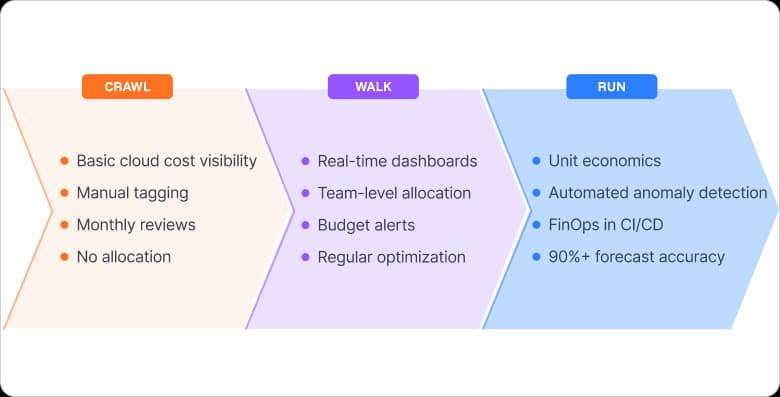
- Crawl: Basic cloud cost visibility, some tagging, monthly billing reviews, no allocation framework
- Walk: Real-time dashboards, team-level allocation, budget alerts, regular optimization cycles, and shared cost models
- Run: Full unit economics, anomaly detection, FinOps embedded in CI/CD, forecasting accuracy above 90%, and executive-level cloud cost accountability
Most organizations are in the crawl stage. Moving to walk requires building allocation and governance infrastructure. Moving to run requires cultural change and tooling that connects infrastructure as code practices with cost governance automatically.
Final Thoughts
FinOps is not a cost-cutting initiative. It is a maturity practice that transforms how organizations relate to their cloud infrastructure. The teams that do it well do not just spend less. They spend smarter, build more efficiently, and scale without the margin erosion that typically accompanies growth.
The path starts with visibility. Once costs are visible and allocated, optimization follows naturally. And once optimization is embedded in the engineering workflow, cloud spend becomes a competitive advantage rather than a financial liability. Every dollar of cloud spend becomes a decision, not an accident. Explore Opslyft's approach to cloud financial management to see how this works in practice.
Frequently Asked Questions
Explore our Frequently Asked Questions for short answers that provide clarity about our services.